How far must you move your chainsaw?
This past weekend, I happened to go to a timbersports competition for the first time.Let’s not inquire as to why.
One category of events in the competition sees timbersportsmen cut through a log with a chainsaw in as little time as possible. Interestingly, the logs at this competition were slightly larger in diameter than the length of the chainsaw blades of the competitors. This led to a fair bit of planning and some rather-complicated chainsaw maneuvering from the contestants, which got me thinking about the following math problem:
You have a log with circular cross-section of radius and a chainsaw of length , where . What’s the minimum distance you need to move the handle of the chainsaw to be able to cut through the entire cross-section (as a function of )?In particular, you’re allowed to rotate the chainsaw arbitrarily at no “movement cost”; the only constraint is that the chainsaw handle cannot enter the cross-section of the tree (since chainsaw handles are thicker than chainsaw blades). Getting the correct answer to this question should be doable for a good high school student. Proving carefully that that answer is correct, however, is an entirely different matter that will take us a little further afield, and give us the opportunity to play with some fun topics in functional analysis and convex geometry. Let’s get started!
Setup
In order to give a careful proof, we’ll need a more formal statement of the problem. We’ll ignore the scaling factor , so that the closed unit ball represents the log. Then given (the chainsaw-length-to-log-radius ratio), we let be the set of absolutely continuous pathsIn other words, those paths for which the arclength integral actually recovers the arclength.
such that, writing for the image, We’ll call paths in admissible: these are the valid paths for the handle of the chainsaw, because the covering condition above captures the free rotation we allow and the codomain enforces that the handle cannot enter the cross-section of the log.
Then the formal version of our informal question above simply asks for the value (up to a factor of that we ignore henceforth) of
Let’s start with an easy warm-up exercise: namely, showing that the supremum in the constraint on paths in can actually be replaced by a maximum. This is the standard first-course-in-analysis exercise that is continuous, which is perhaps most easily accomplished via showing the stronger statement that is 1-Lipschitz using a quick triangle-inequality argument. This lets us talk about “the worst point of the log” later, which we will want to do once we’re actually doing geometry and not just functional analysis.
The plan
Here is the claim we’re going to spend the rest of this post proving.Theorem. For , and the infimum is attained by traversing any closed arc of the unit circle of angular width (without backtracking).Our approach can be broken into three separate steps, which draw on three different fields:
- Functional analysis: a shortest admissible path exists.
- Convex geometry: radially projecting a path onto the unit circle never hurts.
- Euclidean geometry: the narrowest admissible arc has arclength .
The direct method
The standard calculus-of-variations technique for showing existence of a minimizer of some bounded-below functional on a space of admissible functions is rather uncreatively called the direct method. The steps of the direct method are:- show that some admissible function (in our case, path) exists;
- take a minimizing sequence of admissible paths;
- use a compactness argument to extract a limit; and
- check that
- the limit is still admissible, and
- the functional (arclength) doesn’t jump up in the limit (i.e., we have lower semicontinuity).
A failed argument
Pick a minimizing sequence , writing Since after discarding finitely many terms we may assume for all . Since each is absolutely continuous, its arclength is computed by the usual integral, so this is the statement that In other words, the derivatives are bounded in . The most straightforward way to construct a minimizer from here would be to extract a weakly convergent subsequence of the derivatives and integrate the weak limit back up into an actual path. In a reflexive space, this would work, because bounded sequences in a reflexive Banach space always have weakly convergent subsequences. Unfortunately is not reflexive, and bounded subsets of need not be weakly sequentially compact. The obstructionThe Dunford–Pettis theorem, which says that a bounded subset of is relatively weakly compact iff it is uniformly integrable, tells us that mass concentration is in fact the only obstruction.
here is mass concentration, exhibited by the classic example . This sequence is bounded in (since each has integral ), but no subsequence converges weakly, because testing against continuous functions shows the only candidate limit is a Dirac delta at (which is not in ).
This is a real problem for our argument, since a minimizing sequence of admissible paths is perfectly free to concentrate its derivative on the time interval and then stand still for the rest of its time. The speeds of such a sequence are, more or less exactly, the concentrating example above.
Reparametrization to the rescue
The derivative-concentration failure mode is kind of stupid in our context, though, since it’s just an artifact of how we parametrized the path, and the only two properties we care about—distance from the image and arclength—are independent of the parametrization of . So we have a sort of gauge freedom, because we don’t have to care about the parametrization. We can use this gauge freedom to replace a path by its arclength reparametrization, which has much better properties, namely:Fact. Let be an absolutely continuous path of arclength . The arclength reparametrization is -Lipschitz (and hence absolutely continuous).To see this, observe that for , is at most the arclength of between and , which is exactly . Also note that is still admissible because it has the same image as . The upshot here is that a uniform Lipschitz bound is a much stronger form of compactness than a uniform bound on derivatives. Indeed, we basically just incant “Arzelà–Ascoli” and get a uniformly convergent subsequence
Which is what we wanted out of our compactness argument to begin with.
, since the uniform Lipschitz bound gives us the equicontinuity hypothesis of Arzelà–Ascoli.
Running the machine
Let’s start from the top with our new reparametrized direct-method approach. We still know that our arclength functional is bounded from below, and we know that an admissible path exists. So let’s let be some minimizing sequence, and let’s replace each by its arclength reparametrization , which (again after discarding finitely many terms) is -Lipschitz. We have three steps left to run:- extract a limit via compactness (in our case Arzelà–Ascoli);
- check that the limit is admissible; and
- check that arclength is lower semicontinuous.
Arclength is not continuous under pointwise or even uniform convergence, however: consider the case of ever-finer zigzags across a segment converging to the segment.
We may now run the rest of the direct-method argument, and conclude that ; we have thus produced a minimizer.
Snapping to the circle
Next we show that radially projecting a path onto the unit circle never hurts: that is, it preserves admissibility and weakly decreases arclength. The key tool is a single fact from convex geometry, used three times.Fact. The nearest-point projection onto a closed convex set is -Lipschitz.
Proof: We first claim that for all . This is obvious for . If some does not satisfy this, then some convex combination has shorter distance to than , contradicting the definition.
Now for arbitrary we have which rearranges to Then Cauchy–Schwarz gives as desired.We now fix and drop from the notation, writing . Take any . Since for all , the composition is precisely the radial projection of the path onto the unit circle . The three remaining properties to check follow immediately from the fact that is 1-Lipschitz:
- Absolute continuity: post-composing with a -Lipschitz map preserves absolute continuity directly from the definition, as every sum is dominated by .
- The covering constraint: for we have , so that for every we have Minimizing over gives , as desired.
- Weakly decreasing arclength: fixing a partition of , the sum for is dominated term-by-term by the corresponding sum for . Taking the supremum over partitions preserves the weak decrease.
A little bit more work with the arclength integral lets us show that all minimizers have image contained in the unit circle.
Back to Euclid
We’re now done with the high-tech math, and can finish our proof with elementary arguments. We need to do two things: first, show that a minimizing path on the unit circle (which we now denote by , implicitly assuming that we have projected to the unit circle) does not backtrack, and second, characterize the arclength of its image as a function of .No backtracking
The image of our projected minimizer is a compact, connected subset of . Unless (which we will rule out later), we claim that no triple satisfies and : in other words, no backtracking occurs. To see this, consider two cases: either or In the latter case, . In the former case, we may define to be on and and to be constant on . Then any partition of containing demonstrates that contradicting our minimizing assumption. Since no backtracking occurs (except for the case), the arclength of a minimizer is determined by its image, which is either or a connected arc in . In the case, we have . To rule out this case, we can simply demonstrate shorter arcs that work for all , which will just take a little bit of high-school geometry.Minor arcs
For , the shorter arcs that work are the green arcs in the figure below. Note that for the arcs collapse to a single point.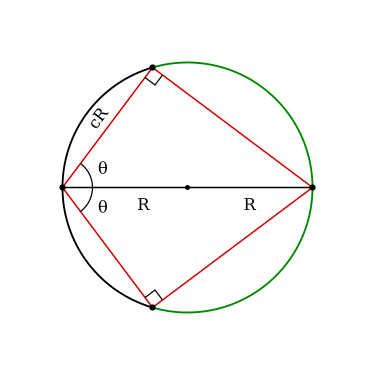
- The blue circular sector has radius 1, so every point along the green arc covers its slice of that sector provided the chainsaw blade is pointed at the center of the log.
- The yellow circular sector has radius , so it passes through or beyond the center of the log at its rightmost extent and passes exactly through the leftmost point on the log. It has to go a little beyond this leftmost point to cut through the cap on the segment of length .
- At , the answer is : park the handle anywhere against the log, and the blade exactly reaches the antipodal point while sweeping out everything else.
- At , the answer is : halfway around the log.
- At — a blade exactly as long as the log’s radius — the answer is , fully two-thirds of the way around the log. (Draw an inscribed hexagon.)
- Finally, the answer is decreasing in , as it had better be.